 Overview
October 1, 2024



Prof. Prof. DK Prof. Dr. med. Marc Possover, MD, PhD
Endometriosis is traditionally considered a gynecological disease.
When endometriosis involves the uterus, ovaries, or pelvic peritoneum, this is correct.
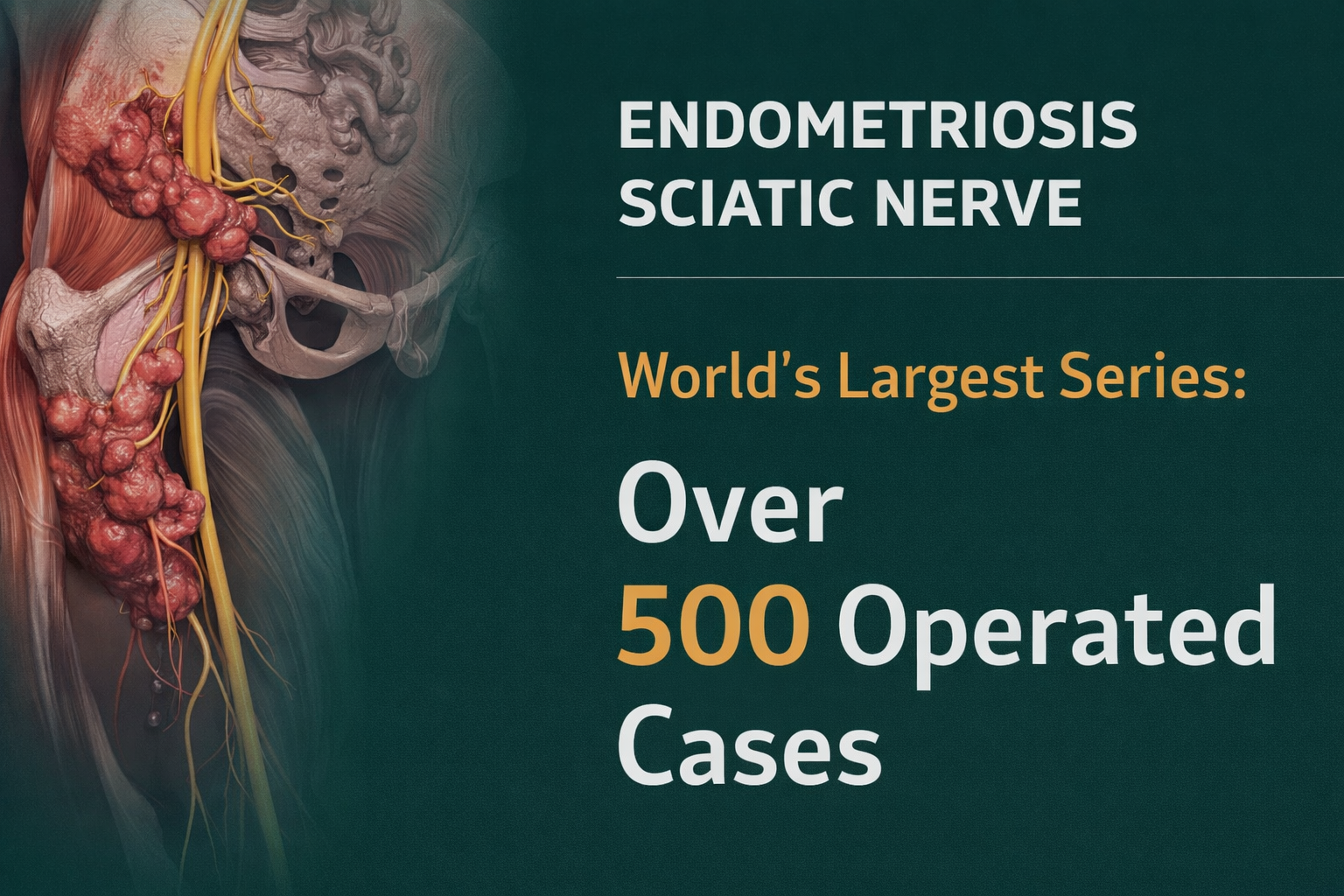
However, endometriosis of the sciatic nerve is not a gynecological disease.
It is a neurological disease occurring inside the pelvis.
And this distinction changes everything.
A Disease of the Nervous System - Not of the Uterus
The sciatic nerve is the largest nerve in the human body.
When endometriotic tissue infiltrates this nerve, the disease affects:
This is not a disorder of reproductive organs, it is a primary pelvic neuropathy caused by endometriotic nerve infiltration.Therefore, the diagnosis belongs to neurology, and the surgery belongs to neurosurgery - not to classical gynecology.
Why Classical Neurology Cannot Diagnose Pelvic Nerve Disease
Here lies the paradox:
Pelvic nerves are deep intrapelvic structures, that cannot be examined with standard neurological testing. The only reliable clinical examination of pelvic nerves is:
These examinations are gynecological by access, but neurological by nature. They are completely outside the training, legal scope, and ethical framework of classical neurology. A neurologist cannot perform intravaginal pelvic nerve palpation. This would be unthinkable and unacceptable.
As a result, pelvic nerve diseases were historically “invisible” to neurology.
They simply had no diagnostic doorway.
Why Classical Gynecology Cannot Treat Pelvic Nerve Disease
Gynecologists are trained in:
They are not trained in nerve diagnostic and not trained in neuro-surgical nerve procedure and reconstruction. Being able to expose a nerve laparoscopically does not make someone a neurosurgeon. Pelvic nerve surgery requires:
This is neuro-surgery - not gynecological surgery.
Neuropelveology: The Missing Discipline
Neuropelveology was created precisely to solve this paradox.
It is the discipline that:
Sciatic nerve endometriosis is a neuropelveological disease.
Its diagnosis is neurological.
Its surgery is neurosurgical.
Its access is gynecological.
Its discipline is Neuropelveology.
A Dangerous Trend: “Social-Media Neuropelveology”
In recent years, a growing number of surgeons have begun to present themselves online as “specialists in sciatic nerve endometriosis surgery” — without:
Self-declaration on social media is not qualification.
Pelvic nerve surgery without neurological diagnosis is blind surgery.
Blind nerve surgery causes permanent neurological damage.
What Patients Must Demand
Patients suffering from sciatic pain, foot drop, pelvic neuralgia or unexplained neurological symptoms must demand:
Not Instagram expertise.
Not self-proclaimed titles.
But science, certification, and proof.
Conclusion
Sciatic nerve endometriosis is not “deep endometriosis.”
It is pelvic nerve disease caused by endometriotic nerve infiltration.
It belongs to neurology by pathology, neurosurgery by treatment, and Neuropelveology by reality.
And it can only be treated safely by those trained in all three.
— Prof. Marc Possover
Founder of Neuropelveology
We’re Here to Help
Possover International Medical Center – Zurich
☎️ +41 44 520 3600
📍 Klausstrasse 4, CH-8002 Zürich
🌐 www.possover.com
📧 mail@possover.com
Let us help you find the cause of your pain - and finally start your journey toward healing.
If you or someone you know is struggling with chronic pelvic pain, pelvic nerve disorders, endometriosis, or consequences of pelvic surgery, please contact us via email at international@possover.com to begin the process. Because we want to avoid the scenario where a patient travels to Zurich, only to discover that we may not be able to offer help for their specific situation, we have Pre-Consultation Zoom process. How does it work?
Prof. Prof. DK Prof. Dr. med. Marc Possover, MD, PhD
...Prof. Prof. DK Prof. Dr. med. Marc Possover, MD, PhD
...Prof. Prof. DK Prof. Dr. med. Marc Possover, MD, PhD
...Prof. Prof. DK Prof. Dr. med. Marc Possover, MD, PhD
...Klausstrasse 4
CH - 8008 Zürich
Switzerland
E-Mail: mail@possover.com
Tel.: +41 44 520 36 00