 Overview
October 1, 2024



Prof. Prof. DK Prof. Dr. med. Marc Possover, MD, PhD
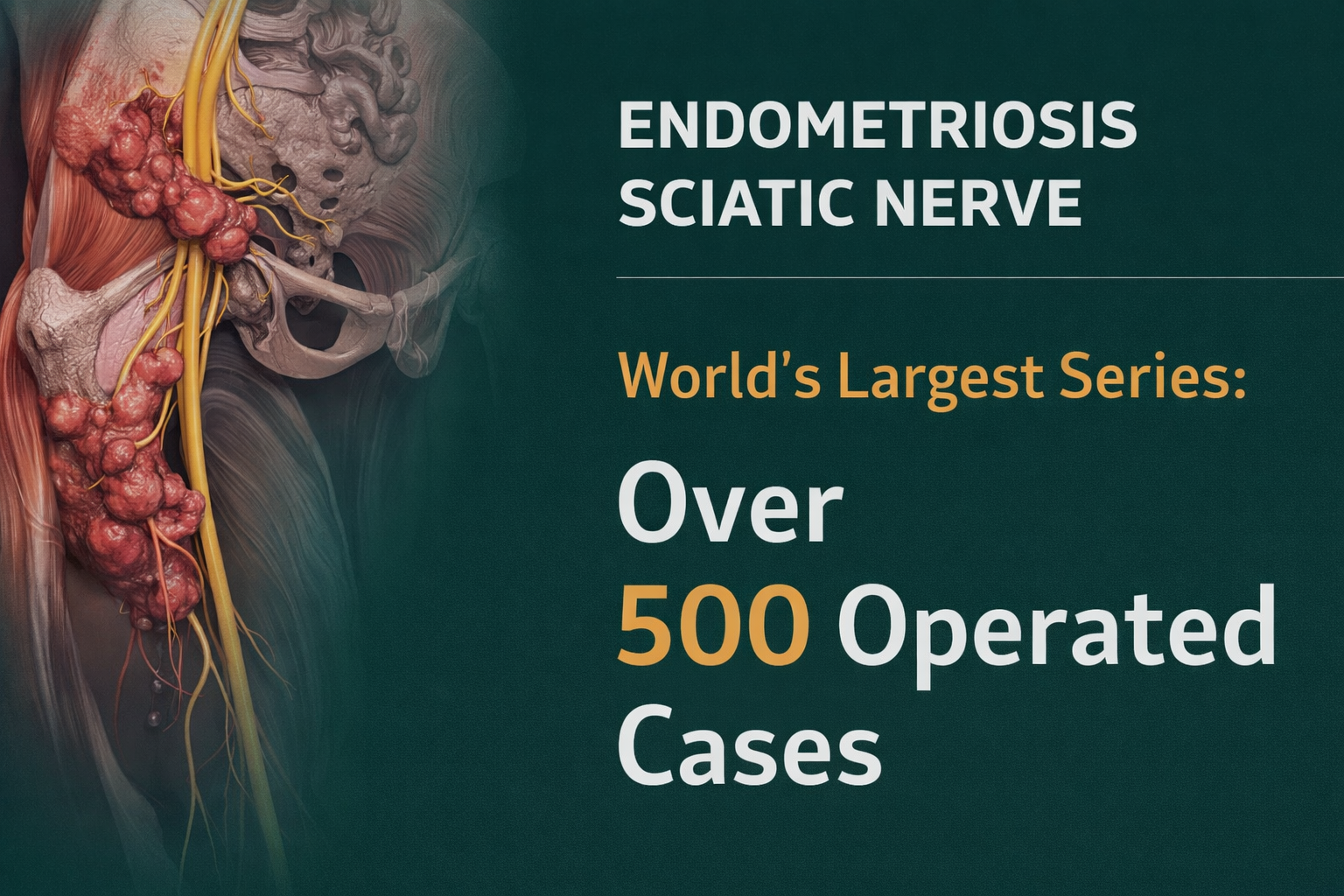
Catamenial Sciatica & Sciatic Nerve Endometriosis
Why Periodic Sciatic Pain Is Not an Orthopedic Problem
By Prof. Marc Possover
When Sciatic Pain Follows Your Cycle
Many women live for years with severe sciatic pain that no doctor can explain.
They are told they have a “back problem,” a “disc problem,” or that it is “just muscular.”
They try physiotherapy, painkillers, injections, sometimes even spinal surgery — and nothing truly helps.
Yet one very important detail is often ignored:
The pain comes and goes with the menstrual cycle.
It becomes much worse before or during the period.
It may calm down afterward, only to return again the next month — often stronger than before.
This type of pain is called catamenial sciatica, and it is not a disease of the spine.
Why Your Back Is Often Not the Real Problem
In classic sciatica, a nerve is compressed in the spine by a disc herniation.
But in catamenial sciatica, the sciatic nerve is usually affected inside the pelvis, not in the back.
Deep inside the pelvis, the sciatic nerve runs through a narrow anatomical space where it can be irritated, inflamed, or even invaded by endometriosis tissue.
When this tissue reacts to monthly hormonal changes, the nerve becomes inflamed and painful, exactly at the time when your cycle changes.
Because standard spinal MRI often looks normal, many women are told:
“There is nothing wrong.”
But the pain is very real.
How Women Describe This Pain
Women with catamenial sciatica often describe a very specific kind of suffering.
They speak of burning, stabbing, electric shock-like pain that starts in the buttock and runs down the leg.
Sitting becomes almost impossible.
At night, the pain can become unbearable.
Many notice bladder pressure, bowel discomfort, or deep pelvic pain at the same time, especially around menstruation.
These symptoms are not random.
They are typical signs of pelvic nerve involvement.
Why So Many Women Remain Undiagnosed
Most doctors look only at the spine when sciatica is mentioned.
Very few are trained to evaluate pelvic nerves.
As a result, pelvic nerve endometriosis and pelvic nerve entrapment are often missed, sometimes for 5, 10, or even 15 years.
During this time, women may feel misunderstood, exhausted, and desperate, while the disease continues to progress.
There Is a Name for Your Pain — And There Is a Cause
Catamenial sciatica is not “psychological.”
It is not “just muscular.”
It is not “in your head.”
It is a neurological disease of the pelvic nerves, very often caused by endometriosis.
Once this is recognized, the pain finally becomes explainable — and treatable.
A Different Way of Diagnosing Sciatic Pain
Neuropelveology is a medical discipline that focuses on pelvic nerves.
Through specialized neurological pelvic examination and targeted imaging, it becomes possible to identify exactly which nerve is affected and why.
This is the key to choosing the right treatment, instead of continuing ineffective therapies.
A Message to Every Woman Who Recognizes Herself Here
If your sciatic pain worsens with your menstrual cycle,
if your MRI is “normal,”
if your treatments have failed,
your pain deserves to be taken seriously.
Your pain has a name.
And your pain has a cause.
And most importantly:
There is a way forward.
………BUT………
Not Every Catamenial Sciatica Is Endometriosis
Why Blind Laparoscopy Can Be Dangerous
Not every catamenial sciatic pain is caused by endometriosis.
Although cyclic sciatic pain is a strong warning sign for pelvic nerve pathology, it does not automatically justify immediate laparoscopy or exploratory surgery.
This assumption has unfortunately led many women into unnecessary – and sometimes harmful – operations.
Every surgical intervention inside the pelvis creates scar tissue.
Scar tissue can narrow natural nerve corridors, irritate pelvic nerves and even generate new chronic neuropathic pain syndromes.
A blind or poorly targeted laparoscopy may therefore worsen pelvic nerve symptoms instead of improving them.
Why Imaging and Laparoscopy Can Be Falsely “Normal”
Unlike sacral plexus endometriosis, sciatic nerve endometriosis often does not develop directly inside the nerve, but in its surrounding pelvic corridors.
These deep intrapelvic segments are extremely difficult to visualize.
For this reason, a negative laparoscopy, ultrasound or MRI does not exclude sciatic nerve endometriosis.
Many women are falsely reassured that “nothing is wrong” — while the disease remains present but hidden.
Surgery Must Never Come Before Diagnosis
The indication for surgery must be based on a precise preoperative neuropelveological diagnosis, not on exploratory laparoscopy.
Neuropelveology allows detailed mapping of pelvic nerve anatomy, identifying:
Only this level of diagnostic precision can define:
Without this diagnostic mapping, surgery becomes blind, dangerous, and unpredictable.
A Wide Nerve With Many Functions
The sciatic nerve is not a single structure with a single function.
It is a broad, complex nerve composed of multiple functional fascicles, each controlling different sensory and motor territories.
Neuropelveological diagnostics identify which fascicles are affected and at what intrapelvic level — a prerequisite for any safe surgical strategy.
Key Message
Catamenial sciatica is a neurological pelvic disease -
not a surgical diagnosis.
Surgery must be the result of a precise neuropelveological diagnosis,
never the starting point.
We’re Here to Help
Possover International Medical Center – Zurich
☎️ +41 44 520 3600
📍 Klausstrasse 4, CH-8002 Zürich
🌐 www.possover.com
📧 mail@possover.com
Let us help you find the cause of your pain - and finally start your journey toward healing.
If you or someone you know is struggling with chronic pelvic pain, pelvic nerve disorders, endometriosis, or consequences of pelvic surgery, please contact us via email at international@possover.com to begin the process. Because we want to avoid the scenario where a patient travels to Zurich, only to discover that we may not be able to offer help for their specific situation, we have Pre-Consultation Zoom process. How does it work?
Prof. Prof. DK Prof. Dr. med. Marc Possover, MD, PhD
...Prof. Prof. DK Prof. Dr. med. Marc Possover, MD, PhD
...Prof. Prof. DK Prof. Dr. med. Marc Possover, MD, PhD
...Prof. Prof. DK Prof. Dr. med. Marc Possover, MD, PhD
...Klausstrasse 4
CH - 8008 Zürich
Switzerland
E-Mail: mail@possover.com
Tel.: +41 44 520 36 00